
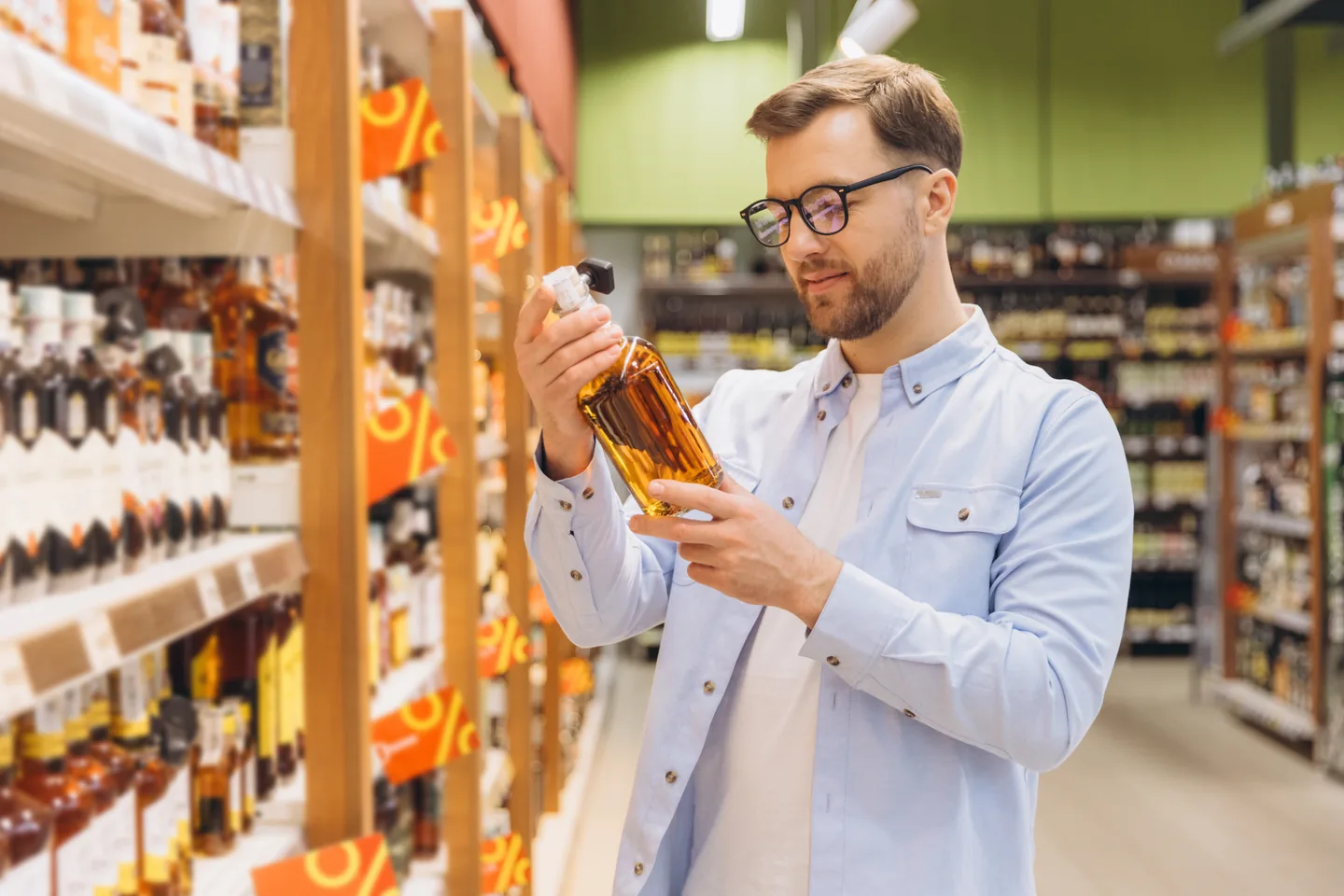

Idaho is not one alcohol market. It is two, running through the same front door, and almost everything that makes the state unusual to insure follows from that split. Distilled spirits are sold through state-operated stores and through contract retail stores the state authorises. Beer and wine are not: they move through private distributors to licensed retailers, outside the liquor division’s oversight entirely.
So an Idaho retailer is on the private side of one channel and, if it carries spirits at all, standing inside the other as an authorised contractor. Those are different legal positions, and the first question we ask on an Idaho submission is which one the store is actually in.
Two channels, two regulators, one counter
The entry behind this page names both bodies. Spirits sit with the Idaho State Liquor Division (distilled spirits). Licensing and enforcement for the beer and wine side sit instead with the Idaho State Police Alcohol Beverage Control (licensing and enforcement for beer and wine). That is not an administrative curiosity — it decides who you ask. A supply question about spirits and a licensing question about wine do not go to the same desk.
The state’s own description of the spirits channel is explicit: distilled spirits are sold only in state-operated liquor stores and in contract retail stores that the division authorises, and the division ships to all of those stores through a contract carrier. The same source is equally explicit about the other half — the division has no oversight of beer and wine, which are handled through private distributors who generally deliver to the retailers.
The licence a private Idaho retailer holds
The off-premises class defined in the Idaho Code is the retail wine licence: a licence issued by the director authorising a person to sell table wine or dessert wine at retail for consumption off the licensed premises. Two words in that definition carry the insurance. “At retail” puts you in the sales chain rather than the supply chain, and “off the licensed premises” means the product leaves sealed and is consumed somewhere you do not control.
What the Code does not create is a private off-premises licence for distilled spirits. On this record, there is no such class to hold. That is a structural fact about the Idaho market rather than a gap in the research, and it is why an Idaho programme is usually built around a wine-and-beer retail exposure with a separate conversation about any contract-store role the business has taken on.
Where Idaho law lets a claim through
Idaho Code section 23-808 is written backwards from the way most people expect. It does not start by creating liability. It starts by removing it: no claim or cause of action may be brought by or on behalf of a person injured by an intoxicated person against anyone who sold or otherwise furnished alcoholic beverages to that intoxicated person. That is the rule.
The claim exists only as an exception to that rule, and the statute defines the exception narrowly. An injured person may bring an action against the seller only if the intoxicated person was younger than the legal age, or was obviously intoxicated at the time. Both limbs are about what was visible at the counter at the moment of sale — an age that could have been checked, or a condition that could have been seen.
That shapes the file more than it shapes the policy. Where liability turns on what a clerk could observe, the defence is assembled from whatever the store wrote down and kept: the identification routine as a document, evidence that it was taught before anyone was left alone at a till, and recordings that outlive the incident. A narrow statutory route in is still a route in, which is what the liquor liability form answers for.
What this page will not tell you about Idaho
Whether Idaho attaches a liability-insurance condition to the licence is not established here. Research reached the licensing sections of the Code and the state police alcohol beverage control pages without finding a clause that settles it in either direction. The table records that as a status rather than an answer, and the prose above stays quiet accordingly. An unverified answer printed confidently is worse than no answer, because you would act on it.
What is established is the workers compensation route. The statute permits an employer to insure the payment of compensation with any insurer authorised by the director of the Department of Insurance to transact that business. It carves out a different rule for public employers, who must place their liability with the state fund unless that fund refuses the risk — a carve-out that does not reach a private retailer. For a store with staff that means the workers compensation line is marketable rather than assigned.
Policies and carriers are the Idaho Department of Insurance’s business rather than the liquor division’s — a distinction worth remembering before a complaint goes to the wrong desk entirely.
What actually moves an Idaho quote
You will not find a premium figure on this page. Any number broad enough to cover every Idaho store would be far too broad to plan against. What is worth setting out is which variables move a submission here, and most of them are inside your control.
Your position in the two channels leads. A store trading wine and beer under a retail licence presents differently from one that has also taken on an authorised contract-store role for spirits, because the second brings state-owned stock and a different set of obligations onto your floor. Sales mix follows: wine-weighted inventory carries higher unit values than a beer-weighted one, which changes the property conversation before it changes the liability one. Then the counter procedure, which in Idaho does more work than usual, because both limbs of the statutory exception are about what a clerk could see. Hours and delivery come next, and loss history closes it out.
Risk patterns in an Idaho liquor store
Cold does something to this class that it does not do to most retail. Everything on an Idaho shelf is liquid in glass, so a boiler that quits on a Friday night in February costs you the inventory long before it costs you the building. Elevation puts that scenario across most of the state rather than only the Panhandle.
Delivery splits into two different exposures depending on where the store sits. In the Treasure Valley it is dense traffic and a doorstep hand-off at the end of the route. Across the Magic Valley, the Panhandle and the eastern corridor it is distance and road conditions, with long return legs and fewer places to stop. Either way the van answers to commercial auto, while what happens once the driver knocks does not.
Claims with no alcohol element in them arrive regardless. Slips inside the door through a wet Idaho winter, falling stock and display collapses, lot injuries on a shared pad site. Those run on general liability, which is written to exclude the alcohol exposure — hence a separate liquor form rather than a bigger single policy. On the property side, theft concentrates in the higher-value wine that resort and border trade carries more of. Stock, structure and theft are all answered on the property half of the schedule.
Major Idaho liquor store markets
Boise and the Treasure Valley
The state capital, the Boise State campus and the Meridian–Nampa growth belt sit inside one continuous trading area, which means a single store can serve a government workforce, a student population and a fast-turning suburban trade in the same week. Underwriting reads that as three different age-check profiles across one register, and the procedure question becomes whether the store trains for the hardest of the three rather than the commonest.
Coeur d’Alene and the Panhandle
Lake traffic and the Spokane spillover give the Panhandle a weekend trade that arrives by car and leaves the same day. The practical effect is on the lot rather than the shelf: parking turns over constantly, stock moves in volume on Fridays, and a store here carries more of its liability exposure outside the front door than a settled residential unit does.
Sun Valley, Ketchum and Blaine County
A resort trade concentrates high-unit-value wine in a small number of stores, and staffs them with a seasonal workforce that turns over between seasons. When a single bottle is worth what a case of beer is, one theft or one dropped crate matters more than a month of small shrinkage — and turnover puts the newest staff on the register in exactly the busiest weeks.
Moscow and the Palouse
A university town on the Washington line, where a large resident student population sits beside a state border that moves with it. The border matters operationally: a clerk here handles out-of-state credentials as routine rather than as an exception, and every unfamiliar document format is a slower check and a likelier mistake.
Idaho Falls and the eastern corridor
The national laboratory complex and the agricultural trade around it produce a shift-work customer pattern, with sales concentrated at shift change rather than spread across the evening. Concentrated demand puts queue pressure on the register, and queue pressure is where a documented identification procedure either holds or quietly stops being followed.
Twin Falls and the Magic Valley
Towns sit far apart across the Snake River plain, so a store that delivers runs longer routes than a Treasure Valley equivalent and spends proportionally more of its programme on the vehicle. Winter road conditions on the plain add a frequency element to that exposure which a compact urban route simply does not carry.
Why Idaho liquor store owners choose Liquor Store Guard Insurance
Because the Idaho answer is structural rather than cosmetic, and a national template does not carry it. A state that sells spirits itself and licenses wine separately produces a different submission from a state that licenses everything through one class, and a statute that bars the claim before allowing it produces a different defence file from one that simply creates a right of action. The programme behind all of this is described on the liquor store insurance page.
Nothing here was carried forward from general knowledge about liquor law. Each point was read off an Idaho source or left out, which is why one row in the table below is blank rather than merely plausible. An agent who holds a licence reads the file, and the reply says what the markets are prepared to do with it.
Nearby states we also write
Idaho borders more states than almost anywhere else in the West, and none of them answers these questions the same way. If you trade across a line, start with Washington, Utah or Montana.
How each Idaho claim on this page was verified
Six rows below resolve to a field we read off an Idaho source; one does not. The table is generated from the same entry objects the prose was written from, so a claim and its evidence cannot quietly come apart later.
| Claim on this page | Entry field | Primary source | Status |
|---|---|---|---|
| Spirits are sold through state and authorised contract stores; beer and wine move privately | control_state | liquor.idaho.gov | Verified |
| Two bodies share alcohol regulation — one for spirits, one for beer and wine | abc_agency | liquor.idaho.gov | Verified |
| The private off-premises class is the retail wine licence | off_premises_licence_class | legislature.idaho.gov | Verified |
| Claims against a seller are barred, then allowed in two defined situations | dram_shop_statute | legislature.idaho.gov | Verified |
| Workers compensation may be placed with any authorised insurer | wc_posture | legislature.idaho.gov | Verified |
| The state insurance regulator | doi | doi.idaho.gov | Verified |
| A state liability-insurance condition on the licence | liability_insurance_required | no source recorded | Not verified |
The federal layer, and where it stops
A package store answers to Washington as well as to its own capital. Registration under 27 CFR Part 31 is filed per place of business, on TTB Form 5630.5d. What follows from it is paperwork with a purpose. Section 31.181 requires records of receipt, and a stock loss is adjusted against exactly that record. In Idaho the licence itself comes from the Idaho State Liquor Division, and the federal registration is separate from it — neither one satisfies the other.
Related reading
Idaho liquor store insurance FAQs
Can a private Idaho business hold an off-premises licence for spirits?
Not on the record this page is built from. The state liquor division states that distilled spirits are only sold in state-operated liquor stores and in contract retail stores it authorises, so the spirits channel runs through the state rather than around it. The private off-premises licence the Idaho Code defines is the retail wine licence, which authorises retail sale of table and dessert wine for consumption off the licensed premises.
Who regulates alcohol retailing in Idaho?
Two bodies, and the split matters when you are working out who to ask. The state liquor division handles distilled spirits, including the state-operated and authorised contract stores. Licensing and enforcement for beer and wine sits with the state police alcohol beverage control function instead. A question about a wine licence and a question about spirits supply go to different places.
Does Idaho let an injured person sue the seller of the alcohol?
Only inside a narrow exception. Idaho Code section 23-808 begins by barring any claim against a person who sold or furnished alcoholic beverages to an intoxicated person, then allows one where the intoxicated person was younger than the legal age or was obviously intoxicated at the time. The general rule is the bar; the claim is the exception, and it turns on facts recorded at the counter.
Does Idaho require a liquor store to carry liability insurance?
This page does not answer that, and the reason is on the record rather than hidden. The field behind it is marked not verified in the trace table below, which means no primary source confirming or denying a state insurance condition was read during research. We would rather show you the gap than fill it from memory. Ask the licensing body that issues your licence before you conclude either way.
How does an Idaho store secure workers compensation?
Through the open market. The statute permits an employer to insure the payment of compensation with any insurer authorised by the director of the Department of Insurance to transact that business, and it reserves a different rule for public employers, who must use the state fund unless it declines the risk. A private liquor retailer is not in that public-employer category, so the line can be marketed.
Does wine inventory change how an Idaho store is rated?
It changes the property conversation more than the liability one. Wine carries higher unit values than volume beer, which moves theft and breakage toward per-incident severity, and it is temperature sensitive in a state with real winter and real summer. A boiler that quits in an unattended stockroom empties the shelves long before it touches the structure, and that is a property question rather than a licensing one.