

A liquor store buys mostly ordinary insurance. Property for the building and the stock, general liability for the floor, workers compensation once there are staff, commercial auto if anything is driven. None of that is unusual and none of it is hard to buy.
What makes this class its own thing is the one policy that is not ordinary, and the fact that the ordinary one is written to exclude it. A general liability form written for a retail store removes liability arising out of furnishing alcohol. That removal is standard, it is deliberate, and for a shoe shop it costs nothing. For a store whose entire inventory is alcohol, it takes out the exposure the business is most likely to be sued over.
This page is the whole picture in one place: who this class covers, which policy answers for which exposure, what an underwriter will ask before quoting, and how the licence calendar interacts with getting bound. Each coverage links through to its own page rather than being re-argued here.
Who this is for
Every store below holds an off-premises licence and sells sealed containers. Minnesota puts the concept plainly in statute — Minnesota Statutes 340A.101 defines off-sale as the sale of alcoholic beverages in original packages for consumption off the licensed premises only. That is one state quoted as an illustration of the concept, not a general rule; the terminology and the licence classes differ elsewhere. What stays constant is the shape of the risk.
-
Package and liquor stores
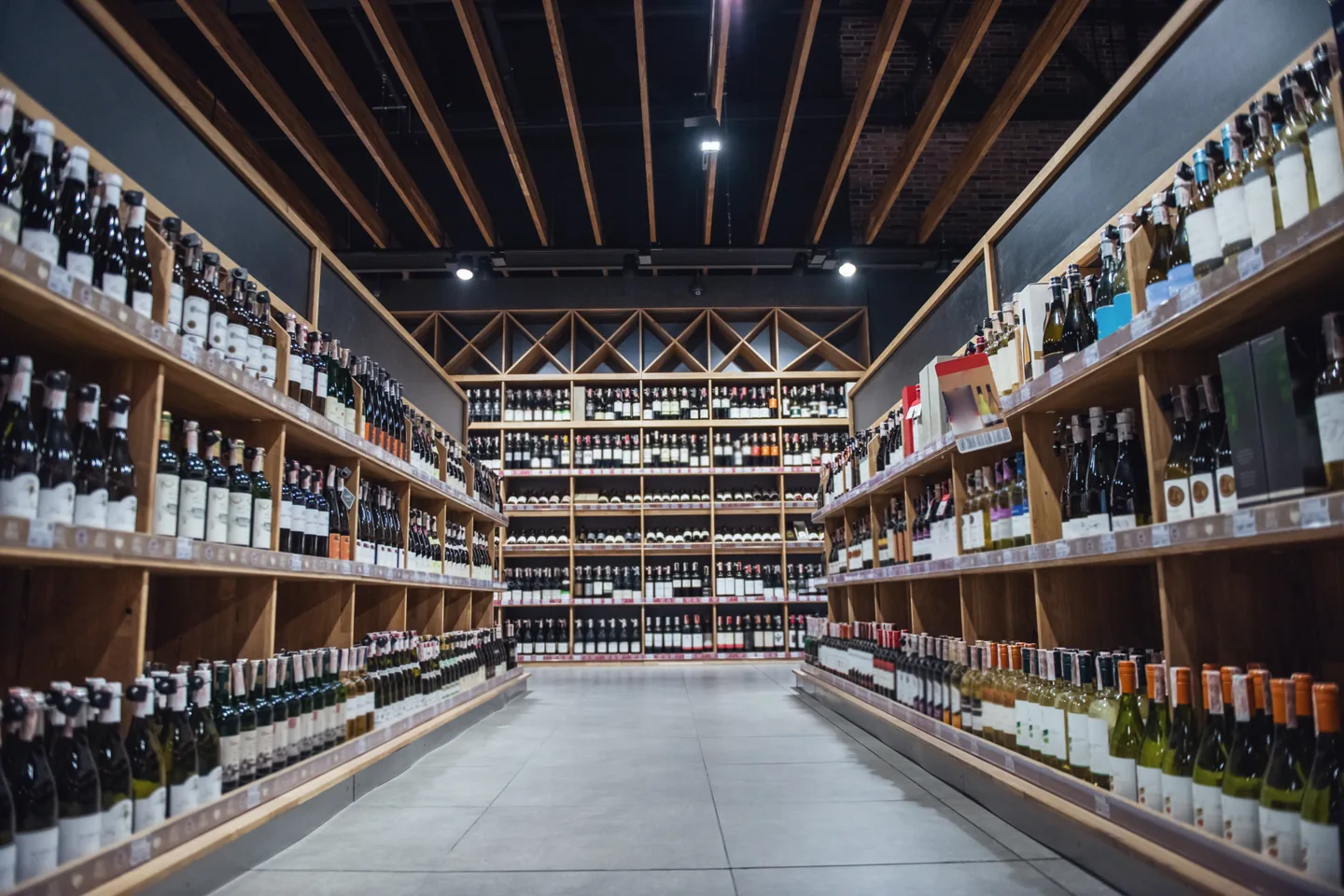
The standalone storefront, and the archetype the rest of this page is written around. Spirits, wine and beer sold sealed for consumption elsewhere. Your exposure is concentrated at the register and in the stockroom: the sale itself, the stock behind it, and the people handling both. What leads here is liquor liability, because the whole business is the sale. Property follows close behind: a standalone storefront usually means you are responsible for the building as well as the stock, so the coolers, the walk-in and the shelving are yours to insure rather than a landlord’s.
-
Wine and spirits shops
A narrower, deeper inventory at higher unit values. The loss picture shifts — breakage and theft matter more per incident than they do in a volume beer store, and a single case can represent what a week of margin looks like elsewhere. Underwriters ask different questions about security and about how stock is stored. Property leads here rather than liability. Higher unit values move the loss picture toward theft and breakage, and the crime section of the package does more work than it does in a volume store. The liquor exposure is real but the transaction count is lower, which usually shows in how the liquor form is rated.
-
Beer and wine convenience-format stores
A smaller licence class and a wider product mix, but far more transactions and far more foot traffic. The alcohol exposure per sale is lower and the frequency of the age check is much higher, which moves the risk toward procedure and staffing rather than toward any one bottle. Liquor liability still leads, but for a different reason: frequency rather than severity. The age check happens far more often, so the exposure lives in whether the procedure holds up across every shift rather than in any single high-value sale. General liability matters more too, because foot traffic is higher.
-
Drive-through package stores
A lane, a window and a canopy change the picture before a single bottle moves. You now have vehicles on your premises, a service point that is not your counter, and a verification moment performed through a car window. Common in some regions and almost unknown in others, which is why a generic retail form rarely contemplates it. This is the one configuration where general liability and commercial auto rise to meet the liquor form. Vehicles on your premises is a premises-liability question; a service point that is not your counter changes where an injury can happen; and a verification performed through a car window is the hardest version of the age check to document.
-
Stores that deliver
Delivery splits your exposure across two policies at once. The vehicle is a commercial auto question; the age check at a doorstep is a liquor liability question. A store that added delivery and revisited neither usually has a gap in both, and this is the fastest-changing exposure in the class. Two lines lead at once and neither covers the other. The vehicle sits on commercial auto — including the hired and non-owned exposure when a clerk uses their own car — while the hand-off sits on liquor liability. A store insured for one and not the other has a gap that only appears at the moment it matters.
-
Stores with tasting or sampling
The moment your store pours, someone is consuming alcohol on your premises under your supervision — an on-premises fact pattern inside an off-premises business. It does not void anything automatically, but a policy written on the understanding that nobody drinks on site is not the policy you want when somebody did. Liquor liability leads, and it leads differently: the theory shifts from a sale to a service, which is the on-premises pattern. General liability matters more as well, because people are standing around in your store rather than passing through it. This is the configuration most likely to be priced on an application that no longer describes the business.
The exposure map
Six coverages carry a package store. The figure below is the same list arranged around the store rather than down a page, because that is closer to how the exposures actually sit — several of them touching the same moment from different sides.
-
Liquor Liability
The sale itself. A claim that your store furnished alcohol to someone already intoxicated, or to someone underage, and that harm followed after they left. This is the exposure that exists because you are a liquor store rather than any other shop, and it is the one a standard retail policy removes.
-
General Liability
Everything that happens on your floor rather than because of what you sold: a slip in the aisle, a display that falls, a cart that strikes a car in the lot. It is the policy every retailer needs, and its liquor exclusion is the reason the line above exists as a separate purchase.
-
Property, Contents and Crime
Your building, your shelves, your coolers, your walk-in and the stock on all of them — plus money and stock taken from you, by an outsider or by someone on your payroll. Crime rides the package policy here rather than standing as its own route, which is how it is actually bought.
-
Workers Compensation
Injury to your own staff rather than to a third party. Cases are heavy, stockrooms are tight, ladders are involved, and the line between this and general liability is simply whose injury it is.
-
Commercial Auto
Owned delivery vehicles, and the shift where a clerk ran an order in their own car. The second one is the exposure stores most often have without knowing, and it does not live on the same policy as the first.
-
Commercial Umbrella
Limits above the policies beneath it — but only above the ones actually scheduled underneath. An umbrella bought over general liability alone leaves the largest exposure in this class with nothing above it.
How the policies are actually bought
Property, contents and crime usually arrive together on a package policy rather than as three purchases, and general liability commonly sits on the same package. That is worth knowing because owners sometimes go looking for a separate crime policy they already have, or assume a package that mentions liability has covered the alcohol exposure. It has not — liquor liability is bought separately in almost every case.
Workers compensation stands on its own, with its own rules and in some states its own state fund. Commercial auto stands on its own too. The umbrella sits above whichever of these are scheduled underneath it, which makes it the policy most often bought with an assumption rather than a check.
Buying a store that already exists
Most people who own a package store did not open one. They bought one, and the insurance conversation at that moment is different from the one at a start-up, because some things transfer with the business and some things very definitely do not.
The licence generally does not transfer the way the lease does. Alcohol licences are issued to a person or an entity for a premises, and a change of ownership usually means an application, a review and a waiting period rather than a signature. That gap is the part that catches buyers: the store can be yours on paper while the thing that lets you sell is still pending, and no insurance policy solves a licence that has not issued.
The stock transfers, and it needs to be insured from the moment of closing rather than the moment your first policy period feels tidy. Inventory is usually the largest single number on a package store balance sheet, and a gap of even a night between the seller’s cover ending and yours starting is a real uninsured exposure on a building full of it.
What surprises buyers most is that the seller’s loss history is underwriting input for you. Claims attach to the location and the operation, not only to the owner, so a store with a history of compliance problems or an alcohol claim carries that into your first submission. It is not disqualifying and it is not a reason to walk away — but it is a reason to ask for the loss runs during diligence rather than discovering them when your quote comes back worse than you expected.
The seller’s policy is not a template for yours either. It was priced on how they ran the store. If you intend to add delivery, extend hours, or start pouring for tastings, the exposure you are buying is not the exposure you are about to create.
Delivery is a compound exposure
Delivery deserves separating out because it is the one change that touches three things at once, and stores almost always insure one of them.
The vehicle is the visible half. Owned vehicles belong on a commercial auto policy, and a personal auto policy will not answer for a car being used in the business. The half stores miss is hired and non-owned: the evening a clerk ran two orders in their own car is an exposure to the business whether or not the business owns anything with wheels.
The hand-off is the invisible half, and it is a liquor liability question rather than an auto one. The verification that happens at your register under lights, with a scanner and a manager nearby, now happens at a doorstep, in the dark, by someone holding a phone and a bag and working against a delivery time. The legal duty does not travel any lighter for the worse conditions.
The driver is the third, and which policy answers depends on who they are. An employee injured on a delivery run is a workers compensation matter. A contractor is a different question with a different answer, and the answer depends on facts your policies were written against rather than on what the arrangement is called.
None of this makes delivery a bad idea. It makes delivery a thing to tell your agent about before it starts rather than after a claim, because a store that added it quietly is usually insured as though it never did.
What an underwriter will ask
Every submission in this class draws the same questions, and having the answers to hand is most of what makes a placement quick.
- Identification and training — whether checking is a written procedure with a record, or a habit. Prices the liquor form.
- Hours and sales mix — how late you trade and how much of the basket is spirits. Prices the liquor form and the package.
- Delivery — whether you do it, who drives, whose vehicle. Prices the auto policy and moves the age check off site.
- Security and retention — cameras, where they point, and how long recordings survive before overwriting. Prices crime, and decides whether you can prove anything later.
- Stock control — how inventory is counted and by whom. Prices employee dishonesty, which is the quieter half of crime.
- Losses and compliance history — including the checks you passed, which nobody will find for you.
- Payroll and staffing — prices workers compensation, and it is the one owners most often leave out of a first submission.
Read down that list again and a pattern shows: almost none of it is asking what you believe. Identification procedure is testing whether a refusal is backed by something a clerk can point to when a customer argues. Training records are testing whether your answer survives the staff member who taught it leaving. Camera retention is testing whether your version of an incident will still exist when a letter arrives months later. Stock control is testing whether a slow loss would be noticed at all, because employee dishonesty is the one exposure that hides inside normal operations rather than announcing itself.
That is why the submission matters more than the negotiation in this class. An underwriter forming a picture of a store from partial answers fills the gaps with the class average, and the class average includes every store that does none of this. Answering completely is not paperwork — it is the difference between being priced as yourself and being priced as the category.
None of these has a right answer that wins a better price on its own. What they establish is whether there is a system, because an owner who can answer them is usually the owner running the controls as well.
Binding speed and the licence calendar
Insurance deadlines in this class are frequently not insurance deadlines. A licensing authority can make evidence of financial responsibility a condition of issuing or renewing a retail alcohol licence — in Minnesota, for example, Minnesota Statutes 340A.409 provides that no retail licence may be issued, maintained or renewed unless the applicant demonstrates proof of financial responsibility. Requirements differ materially between states and we verify them per state rather than generalising, but where one applies the consequence is the same: a gap stops being an uninsured period and starts being a licensing problem.
Practically, that means we work backwards from your licence renewal date rather than your policy expiry, and it is why an incomplete submission costs more here than it does in most classes.
Why Liquor Store Guard Insurance
Most agencies can sell a liquor store six policies. The work is in the joins. Whether the umbrella sits over the right underlying policies, whether the package and the liquor form leave a seam between them, whether the delivery operation reached the auto policy but not the age-check exposure — those are the failures we actually find, and none of them is visible from inside a single policy.
Being independent is what makes that possible to fix rather than just to notice. Appetite for retail alcohol moves; a market that wanted this class last year may not want it this year. Knowing that before your renewal does is most of what an independent agency is for, and it is why we would rather quote the whole programme than the one line you called about.
Learn more
- Liquor Liability
- General Liability
- Property, Contents and Crime
- Workers Compensation
- Commercial Auto
- Commercial Umbrella
- States we serve
- Guides for liquor store owners
Alcohol regulation is local, and the state pages carry what each state’s own sources establish. The busiest of them:
- Colorado liquor store insurance
- Texas liquor store insurance
- Ohio liquor store insurance
- New York liquor store insurance
- Vermont liquor store insurance
- Nebraska liquor store insurance
- Maine liquor store insurance
- Georgia liquor store insurance
- Illinois liquor store insurance
- Indiana liquor store insurance
Primary sources: the Alcohol and Tobacco Tax and Trade Bureau on federal alcohol regulation; Minnesota Statutes 340A.101 for the statutory meaning of an off-sale licence, quoted as one state’s example; OSHA on the workplace duties that sit alongside this cover.
Frequently asked questions about Liquor Store Insurance
What does a liquor store insurance programme normally include?
A package policy carrying property, contents and crime, general liability alongside it, and a separate liquor liability policy for the sale itself. Add workers compensation once you have staff, commercial auto if you own vehicles or deliver, and an umbrella above whichever of those you want more limit over. The pieces are ordinary; what is specific to this class is how they fit together and which one carries the exposure you are most likely to be sued over.
Is liquor liability really separate from general liability?
Yes, and that is the single most important thing on this page. A general liability policy written for a retail store excludes liability arising out of furnishing alcohol. For most retailers that removal costs nothing. For a store whose entire inventory is alcohol, it removes the exposure the business exists around. The two policies are designed to meet without overlapping, which means a gap is easy to carry without noticing.
Does the kind of store I run change what I need?
It changes the emphasis rather than the list. A drive-through has vehicles on the premises. A store that delivers moves its age check off site. A shop selling higher-value bottles cares more about theft and breakage per incident. A store that pours for tastings has an on-premises exposure its licence does not obviously suggest. The programme is recognisable across all of them; the underwriting is not.
What will an underwriter want to know?
How you check identification and whether that is written down. What training your clerks get before working a register alone. Your hours, and how late you sell. Your sales mix, and how much of it is spirits. Whether you deliver, who drives, and whose vehicle. Your security and your camera retention. Your prior losses and your compliance history, including the checks you passed. The answers matter less than having them.
How quickly can cover be bound?
Usually faster than owners expect, provided the submission is complete. What slows a placement is almost never the market — it is missing information about hours, training, delivery and losses, which underwriters ask for in every case. Because a licensing authority can condition issuance or renewal on evidence of insurance, the licence date rather than the policy date is often the real deadline.
Do you write stores outside your home state?
We are licensed across most of the country and place this class in each of those states. Alcohol regulation is genuinely local, though — licence classes, dram-shop reach and any insurance requirement differ state to state and sometimes by municipality. We verify those per state rather than generalising, which is why the state pages exist separately from this one.